


Senior Citizen Savings Scheme (SCSS) 2026
What is Senior Citizen Saving Scheme?
The government offers the Senior Citizens Savings Scheme (SCSS) for individuals aged 60 and above. It offers a quarterly interest rate of 8.20%. With a minimum deposit of ₹1,000 and a maximum of ₹30 lakh, it has a 5-year maturity period, extendable by 3 years. SCSS provides regular income, tax benefits, and allows premature withdrawals under certain conditions.

Tenure | Five years |
Interest Rate | 8.20% p.a. |
Investment Amount | Maximum amount that can be deposited is Rs.30 lakh |
Premature Withdrawal | Allowed |
Benefits of SCSS
The following are the benefits of SCSS:
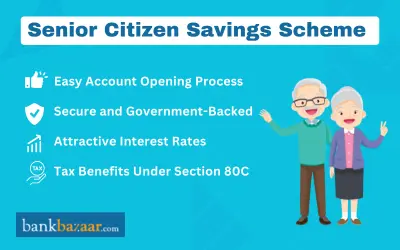
- You can easily open an SCSS account at any post office or authorized bank across the country.
- The government backs SCSS, making it a trustworthy investment.
- The scheme offers high rate of interest.
- You can open an SCSS account for five years and extend it for up to three more years.
- You can transfer the account anywhere across the country.
- You can claim an income tax deduction of up to Rs. 1.5 lakh under Section 80C of the Indian Tax Act 1961 for this scheme.
Features of Senior Citizen Saving Scheme
Here are the main features of the Senior Citizens Savings Scheme:
- Maturity of the scheme: The maturity period of the scheme is five years. However, individuals can extend the maturity duration for three years by submitting an application in the required format within one year of maturity of the account. You can close the account without any charges after it expires.
- Nominations: You can add nominations to the policy when you open the account or anytime afterward.
- Number of accounts: Individuals can operate multiple accounts by themselves or open a joint account with their spouse. However, they can open joint accounts only with their spouse, and the initial depositor is the investor of the joint account.
- Minimum and maximum amount: You can make a single deposit in the account in multiples of Rs. 1,000, up to a maximum of Rs. 30 lakh. Pay deposits under Rs. 1 lakh in cash, and deposits over Rs. 1 lakh by cheque. In the case of cheque payments, the date the cheque realises will be the opening date of the account.
- Transfer of an account: You can transfer your SCSS account from a bank to a post office or from a post office to a bank. The process to open an SCSS account is also easy and hassle-free.
- Premature withdrawal: You can make a premature withdrawal after one year of opening the account. We charge 1.5% of the total amount if you withdraw after one year and 1% if you withdraw after two years.
Eligibility for Senior Citizen Savings Scheme
Below are the eligibility criteria for the SCSS:
- An individual who has attained the age of 60 years or above at the time of opening an SCSS account.
- Individuals who have reached the age of 55 years old but are below the age of 60 years old and have retired on superannuation are eligible to open an SCSS account.
- Individuals who have attained the age of 55 years old and have retired before the implementation of the SCSS rules are eligible under the scheme.
- Non-Resident Indians (NRIs) are not eligible to open an SCSS account.
- Hindu Undivided Families (HUF) are not eligible to open an SCSS account as well.
Documents required to open SCSS account
ven below are the documents that individuals must submit in order to open an SCSS account:
- Two passport-size photographs.
- You must completely fill in and submit Form A.
- You must submit identity proof such as a Passport or PAN Card.
- Individuals must submit proof of address such as Aadhaar Card or telephone bill.
- You must submit a document that confirms your age. Age proof document can be the Permanent Account Number (PAN) Card, Voter ID, Birth Certificate, Senior Citizen Card, or Passport.
You must self-attest all documents submitted to open an account.
Tax benefits under the SCSS
Under Section 80C of the Income Tax Act, 1961, individuals are eligible for tax deductions on investments up to Rs.1.5 lakh. In case the interest generated is more than Rs.10,000 p.a., the tax will be deducted at source.
How Does the Senior Citizen Saving Scheme (SCSS) Work?
Opening an Account
- Open an SCSS account in a single instalment by contributing between Rs.1,000 to Rs.30 lakh.
Deposit Timeline
- The amount must be deposited within one month from the date of receiving the retirement benefit from your employer.
What Qualifies as Retirement Benefit?
The retirement benefit includes:
- Retirement or superannuation gratuity
- Leave encashment
- Retirement-cum-withdrawal benefit under the Employees’ Family Pension Scheme Ex-gratia payments under a voluntary or special voluntary retirement scheme
- Provident fund dues
- Commuted value of pension
- Savings element of Group Savings Linked Insurance Scheme payable by the employer on retirement
Excess Deposit?
- If the deposit exceeds the ceiling amount, the excess will be refunded immediately to the accountholder.
Interest Payout
- Interest is paid quarterly
- Can be withdrawn via: ECS (Electronic Clearing Service)Auto credit through post office
Premature Closure
- The account can be closed at any time after opening.
Extension Option
- After maturity, the account can be extended for another 3 years
- Extension must be done within one year from the date of maturity
Process to Open a Senior Citizens Savings Scheme
You can open an SCSS account at a bank or post office. Follow the steps below to open your SCSS account:
- Visit the nearest post office or bank branch.
- Submit the application form along with the Know Your Customer (KYC) documents.
- You must provide a cheque for the amount you are depositing.
- You can add nominees to the account.
How to open a SCSS account at Bank?
Step 1: Find the nearest bank branch offering SCSS services.
Step 2: Complete the application form with all required details.
Step 3: Attach supporting documents, like your employer’s letter confirming pension or retirement benefits.
Step 4: Submit the application and deposit to the bank staff.
Step 5: Once your payment and application are processed, your SCSS account will be opened.
How to fill in the Post Office SCSS application form?
Here are the steps to fill the Post Office SCSS application form:
- Enter the Post Office branch name
- Enter the account number if you already have the savings account with Post Office
- Enter the branch address of the Post Office under the ‘To’ section
- Paste the photograph of the accountholder
- Enter the name of the accountholder and tick on SCSS option
- Only if you are applying to open a savings account, select any options provided under the ‘Additional Facilities Available’ section
- Select accountholder type, such as minor through guardian, person of unsound mind through guardian, or self
- Select the account type, such as single, survivor, or all
- Enter deposit amount both in figures and in words
- Enter the cheque number and date if you deposit via cheque.
- Enter the accountholder’s personal details
- Tick the boxes at the end of the table for the documents that you have provided as requested
- Enter the details of the SCSS and tick the declaration box
- Accountholder must sign on both page one and two
- Enter the details of the nominee and provide the accountholder’s signature to validate the details mentioned about the nominee
PAN and Aadhaar Mandatory to Open SCSS Account
- When opening an SCSS account, if you don’t have an Aadhaar number, you must provide proof of Aadhaar application or enrolment ID.
- You need to submit your Aadhaar number to the Accounts Office within six months of opening the account.
- If you didn’t provide your PAN at account opening, you must submit it within two months after any of these happen:
- Account balance exceeds ₹50,000.
- Withdrawals/transfers in a month exceed ₹10,000.
- Total credits in a financial year exceed ₹1 lakh.
- Failure to submit Aadhaar within six months or PAN within two months will lead to the account becoming inactive until the documents are provided.
Common Mistakes to Avoid in SCSS
- Wrong Age – Must be 60+ (or 55+ with retirement benefits).
- Missing Documents – Provide valid PAN, Aadhaar, proof of age.
- Over Limit – Max ₹30 lakh per person.
- Multiple Accounts – Only one SCSS account allowed.
- No Nominee – Always add a nominee.
- Form Errors – Use correct and complete forms.
- Joint Account Confusion – Spouse can join, but only your age matters.
- Ignoring Lock-in Rules – Premature withdrawals have penalties.
How to Close Your SCSS Account
1. After Maturity (5 Years)
- Visit your bank or post office.
- Submit a written request with your passbook and ID.
- You’ll receive the full amount with interest.
- No penalty applies.
2. Before Maturity (Premature Closure)
- Allowed only after 1 year.
- Submit Form-2, passbook, and ID.
Penalties:
- 1.5% deduction if closed between 1–2 years.
- 1% deduction if closed after 2 years.
Note: No interest is paid if closed before 1 year.
Popular Pages from Saving Scheme
FAQs on Senior Citizens Savings Scheme
1.Can you extend an SCSS account?
Yes, you can extend it for three years within one year after maturity.
2.Can you transfer an SCSS account from one deposit office to another?
Yes, you can transfer it using Form G
3.Can both spouses open separate SCSS accounts?
Yes, both spouses can open individual SCSS accounts. Each spouse can deposit up to Rs. 15 lakh, following the scheme’s rules.
4.What is the share of the joint account holder in the deposit?
The entire amount belongs to the first depositor or applicant. The addition of a spouse as a joint account does not matter in this case.
5.Is there a minimum limit for tax deduction at source?
Yes, the government requires TDS to be deducted based on the minimum balance.
6.Can a person who is holding the Power of Attorney sign for the nominee in the nomination form?
No, a person holding a Power of Attorney cannot sign in place for the nominee in the nomination form.
7.In the case of a joint account, if the first holder / depositor expires before maturity, can the account be continued?
Yes, the nominee can hold the account of the expired depositor in case of a death, provided it pertains to the SCSS Rules.
8.Is there any fee prescribed for nomination and / or change / cancellation of nomination?
No fee is charged.
9.What will happen to my SCSS account if I were to pass away?
If you have opened an individual account (without any joint investor) and unfortunately, you were to pass away unexpectedly, the SCSS account will be primed up for closure. To affect such a termination, the account holder's nominee must forward an application in Form 'F'. The Annexures II & III of such a form must be attested by a public notary or the Oath Commissioner.
10.Can an account holder obtain loan by pledging the deposit / account under the SCSS, 2004?
Periodic withdrawals for loans are not possible in this scheme as it defies the very nature of the scheme
11.Is premature withdrawal of the deposits from the accounts under the SCSS, 2004 permitted?
Yes, premature withdrawals are allowed, although a premature closure of the savings account is permitted only after a year, whereby the account holder will be charged 1.5% of the savings and 1% after two years.
12.Are Non-resident Indians, Persons of Indian Origin and Hindu Undivided Family eligible to invest in the SCSS, 2004?
No, it is not possible, though an Indian moving abroad and having a SCSS can continue to maintain it.
13.What happens if an account is opened in contravention of the SCSS Rules?
The account will be closed, interest deducted, and the deposit money returned to the depositor.
14.What documents must be submitted when opening up a senior citizen's savings scheme account?
Essentially, the documents that help the bank ascertain your age are required when opening up the SCSS account. These include, Passport/ Birth Certificate/ Voter's ID/ Senior Citizen Card/ PAN, etc.
15.Can I cancel or change my nomination?
When applying for the SCSS account, you are free to propose a nominee. This activity can also be completed after your account has been in existence for a specified duration of time. Alternatively, the nomination made by you can easily be canceled or edited by submitting a fresh nomination in Form-C to the bank/post office wherein said SCSS account is being maintained.
16.I keep hearing the term 'retirement benefits', what does this mean exactly?
When speaking of eligibility for the senior citizens savings scheme, people belonging to the age group of 55 years- 60 years can apply, provided that they must open this account within one month of receipt of 'retirement benefits'. Also, the amount invested must not exceed the net value of the 'retirement benefits'.
17.My wife is just 45 years old: can I appoint her as partner in a joint account?
Since you already have an SCSS account, you are free to appoint your spouse as the joint account holder. It's your age that is the qualifying factor here and not your wife's. Thus, her age doesn't affect her eligibility to act as your joint partner in the account. However, the converse of this isn't possible as your wife is just 45 years old and the minimum age to be eligible to own a SCSS account is 60 years.
18.What to keep in mind before opening an SCSS Account?
Before you open a Senior Citizens Savings Scheme account, ensure that you provide all the necessary information that has been requested. If it is found that the information provided by you is incorrect or false, the account shall be closed with immediate effect. The deposited amount will be refunded to the depositor after the deduction of interest that has already been paid into the account.

Karishma VP has over a decade of experience in content writing which includes over five years specializing in personal finance. Her career in BankBazaar has given her the opportunity to write on a wide variety of financial products ranging from credit cards and home loans to insurance policies and government schemes. She believes that an understanding of personal finance is an important step to leading an independent, empowered life. This has led to her being passionate about learning more about the BFSI sector and writing about personal finance as clearly, concisely, and accurately as possible to make it accessible to a larger audience through BankBazaar.

Disclaimer
Credit Card:
Credit Score:
Personal Loan:
Home Loan:
Fixed Deposit:


Copyright © 2026 BankBazaar.com.